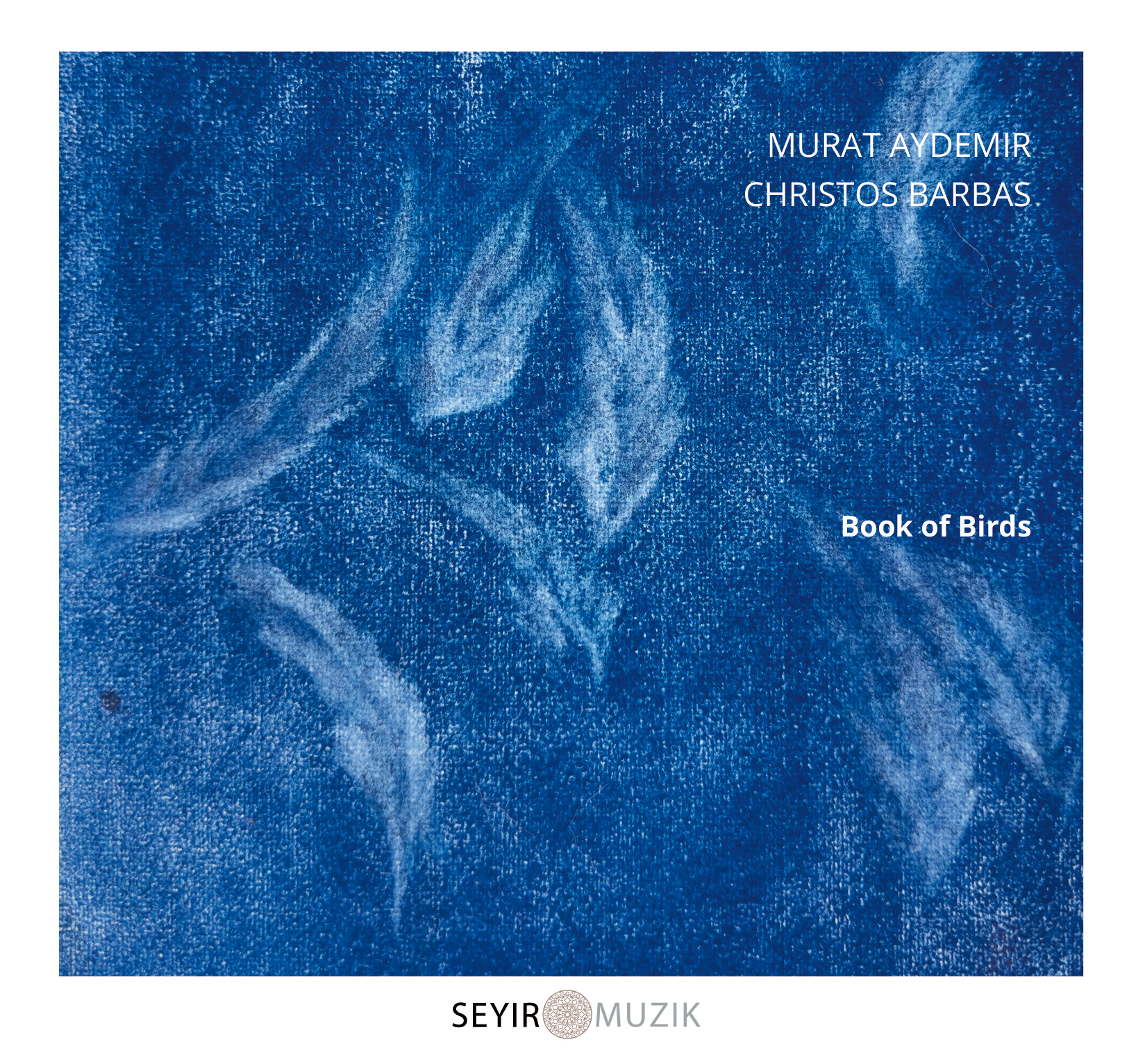
Seven years ago, Murat Aydemir and Christos Barbas recorded their first album The Mountain and the Tree in Istanbul, containing original compositions for Tanbur & Ney. Since then, they have played concerts in Greece, Spain, Japan & Cyprus, further developing the interaction and relationship between them. In their newest album Book of Birds, recorded in Brussels for the Seyir Muzik label in October 2024, they present a collection of contemporary compositions inspired by and based on the modal traditions of the wider Middle Eastern and Mediterranean worlds. Their unique mastery of their instruments serves as a prism, a meeting point for different pieces from different composers to take shape.
 The duo of Tanbur and Ney is considered to be the perfect vehicle for the development and expression of the classical makam of the Ottoman-Turkish tradition, especially in the classical body of music and in the ritual repertoire of the Mevlevi order. Wanting to expand further and present new repertoire, the two musicians invited their friends – prominent figures in the world of modal music, Ross Daly, Kelly Thoma, Evgenios Voulgaris, and Sokratis Sinopoulos – to contribute pieces they felt could suit the duo.
As the album evolved, the theme of birds emerged, a recurrent motif in Sufi poetry with multiple and diverse symbolisms: birds represent the connection between the material and the spiritual realm; they are intermediaries between earth and sky, messengers from the beyond. In folk stories, they often speak the language of humans. Birds also convey a powerful reminder of the importance of community: the pertinence of a group as a vehicle for learning, sharing and growing, as complex and multi-dimensional relations and formations are being created, flocks, for passing on older stories and even creating new ones; in our case a book of musical stories.
Through the rich sound of the Tanbur, with its natural harmonic aura created by the sympathetic strings, and the airy, meditative sound of the Ney, Murat Aydemir & Christos Barbas give their own version of the story – reading the Book of Birds and navigating by way of improvisation, attentive listening, and careful nuance through this world of sounds, colors, and spirits.
 Book of Birds reflects the Turkish-Greek duo’s artistic growth, their commitment to refining and pushing forward the boundaries of their art, and stands as a testament not only to their friendship and profound connection to their roots and community, but also to the labour and creativity of a much wider collective of artists and a musical scene built over the last decades around, though not confined to, the Labyrinth Musical Workshop – the place where they first met and played together.
More information
 Each composition in Book of Birds carries a story of its own, shaped by a different composer. Each melody sprang from a unique moment in time and has a life of its own since then. Epistrophy he opening track of the album was composed by Ross Daly back in 2002, during a journey to England to attend his father’s passing. The piece was recorded soon after and included in his album Microkosmos in 2004. Ross recalls that the music came to him quickly; on the day of his father’s funeral, he encountered a verse by Rumi that struck him deeply: “When light returns to its source, it takes nothing of what it has illuminated.” The phrase seemed to capture the essence of those days, inspiring both the piece and its title: Epistrophy – from the Greek word for “return.”
Uşşak Saz Semai is the only composition in the album drawn from the older repertory of Ottoman Classical music, composed by Neyzen Aziz Dede (circa 1840 –1905). Aziz Dede was one of the great Ney players and composers of the 19th century. He was born in Üsküdar, Istanbul, and traveled in his twenties to Egypt, where he attended the Cairo Mevlevi Lodge and took up music classes; it was there that he also learned to play the Ney. He became a “Dede” after completing a thousand-and-one-day ascetic period, a tradition of the Mevlevi order. He was later appointed chief Ney player at important Mevlevi Lodges such as Galata, Üsküdar, and Bahariye.
Chrysaetos, Peregrine & Rose give their names to musically improvised intermezzi in the album that either introduce or connect compositions together. Sometimes as solo instruments, other times as a duet, Ney and Tanbur investigate and bring to life the modal material of each piece. Each makam or mode is traditionally associated not only with a specific atmosphere and mood but even with ethical states that can be transmitted from the musician to the listener. Ethos provides a framework that goes beyond mere notes, dictating specific melodic movements, characteristic formulas, ornamentation, and overall expressive tendencies within a musical tradition. While specific emotions are subjective and vary across traditions, the core idea is that each mode carries a distinct quality that shapes the listener’s experience and the overall meaning of a musical composition or improvisation.
 Evsat, the composition brought by Murat Aydemir, reflects both his deep roots in and his personal contribution to the style of the Turkish classical tradition. Murat is widely recognized as one of the leading contemporary tanbur players, drawing from years of study and performance while seeking new ways of expression. The piece is based on the usûl Evsat, a 26-beat rhythmic cycle rarely encountered in today’s repertoire. Its unusual structure, formed by combining patterns such as Türk Aksağı and Sofyân, lends the composition both elegance and vitality, and highlights Murat’s ability to bring tradition into a fresh, living context.
Starlings is the title given in the album to a piece Christos Barbas originally composed in 2013 while traveling in Italy with fellow musician Peppe Frana. The two were on a train to the city of Forlì, which is why the piece is often referred to as “Forli Saz Semai.” For this recording, Christos composed a new 4th hane – a closing melody – designed to better reflect the style of Tanbur playing. The original ending had been written in a lively curcuna rhythm, more suitable for instruments such as the oud or kemenche.
 The ancient image of the swan’s final song – the most beautiful it ever sings – has long symbolized a moment of transcendence, a passage from one state of being to another. In his composition Swan Song, a Peşrev in the makam Nihavend, Evgenios Voulgaris draws on this image to speak of the redemptive power of music. Just as the swan’s last song transforms suffering and the fear of an uncertain future into beauty, so too can music illuminate the trials and difficulties that each one of us encounters in life. At times the piece takes on a confessional, almost pleading quality, giving voice to what cannot otherwise be spoken. Evgenios notes that more than offering answers to life’s greatest questions, he believes that music and singing – especially the improvised vocal traditions of the amanes in Greek and the gazel in the Ottoman-Turkish tradition, which greatly inspire his work – create a vital connection between the individual and the community. Through the act of sharing, releasing, and putting into sound what needs to be expressed, music carries out an almost therapeutic function: a lightening of the heart, giving strength in the way forward to continue on our path.
 Nihavend Saz Semai and Trails are two compositions by Sokratis Sinopoulos and Christos Barbas that also reflect the long and rich traditions of musics from Istanbul. Sokratis, a widely acclaimed virtuoso of the kemençe, recalls that he composed his piece during a period when he was traveling between Greece and Turkey, studying makam side by side with traditional Greek music. He talks about the feeling of nostalgia but also the need of belonging that are intertwined in his music: playing and learning an instrument from a seemingly foreign tradition that nonetheless felt familiar in his hands – not only because of the intimacy of its sound but also because similar pear-shaped fiddles, lyras, have existed throughout Greece since the Byzantine era.
 Garden of Labyrinth & The Dancing Owl, the composition by Kelly Thoma, carries us back to Crete and the Labyrinth Musical Workshop, housed in the old museum of musical instruments in Houdetsi. For over twenty years, this place and its garden have been a hub of musical encounters, concerts, and seminars, nurturing a vibrant community of musicians.During a concert in the summer of 2010, Ross & Kelly were performing this piece as a duet in the garden when a white owl – otherwise known for its excursions in the garden and for flying around the village in search of food for her young – poked her head out of a hole in the building, where she had apparently built her nest, and began to sway her head around, dancing in a wild 180° rotation! The scene was captured on video by Christos and can still be found on YouTube. From this enchanting encounter, the composition took its title, and the little bird seemed to have found her song.
The closing piece of the album, Sparrow Song, is also connected with the same period, when Christos was living in the mountains around Houdetsi, where encounters with little sparrows were a common sight just outside the door of his house. The composition has already been recorded twice by Neda Quartet, once in its instrumental version and once as a song. Murat and Christos had already performed this piece live in concerts, and the modest encounter of voice, tanbur, and ney felt fitting as the last track of the album. The lyrics in Greek garment the melody, which is presented in a varied form of a slow ten-beat rhythm, the Aksak Semai, typically found in a classical song form called Ağir Semai – literally “heavy” or “slow” in Turkish. Likewise the song, over its twelve minutes of duration, recounts the adventures of a little sparrow – from its birth and first appearance, through its dreams, journey, and trials, to its eventual transformation into a golden eagle and its twofold return (epistrophy): to its original faraway home in the sky, and to the hearts of the storyteller and listeners in the form of a song. The path of this journey is strewn with signs, weaving threads, so that new-comers and other sparrows, listening to the song, can also find the path and begin their own journey – anew – towards the light.